

Table of Contents
ToggleSmall patios don’t have to mean limited comfort or cramped seating. L-shaped sectionals are game-changers for compact outdoor spaces, offering the seating capacity of a full sofa set while hugging corners and walls to free up floor area. Whether you’re working with a narrow balcony, a tight urban courtyard, or a modest deck, the right L-shaped configuration can transform an awkward footprint into a functional, inviting gathering spot. This guide walks through sizing, materials, layouts, and smart features to help homeowners choose and position L-shaped patio furniture that actually fits, and works.
Key Takeaways
- L-shaped patio furniture for small spaces consolidates seating along walls or corners, freeing up the center for traffic flow while providing the capacity of a full sofa set.
- Measure your patio carefully and use painter’s tape to outline the furniture footprint at full scale—testing the layout for several days prevents costly sizing mistakes before delivery.
- Choose aluminum frames with powder-coated finishes or PE resin wicker for durability and easy repositioning; invest in quality solution-dyed acrylic cushions like Sunbrella to avoid fading within a season.
- Corner placement maximizes usable floor area, but wall placement can be smarter for patios with off-center doors or narrow access points—test both orientations before committing.
- Prioritize multi-functional features like under-seat storage, lift-top seats, and convertible ottomans to ensure every piece in your small patio serves double duty.
- Look for modular rather than welded L-shaped sets to allow flexibility for future moves or reconfiguration as your needs change.
Why L-Shaped Furniture Is Perfect for Compact Patios
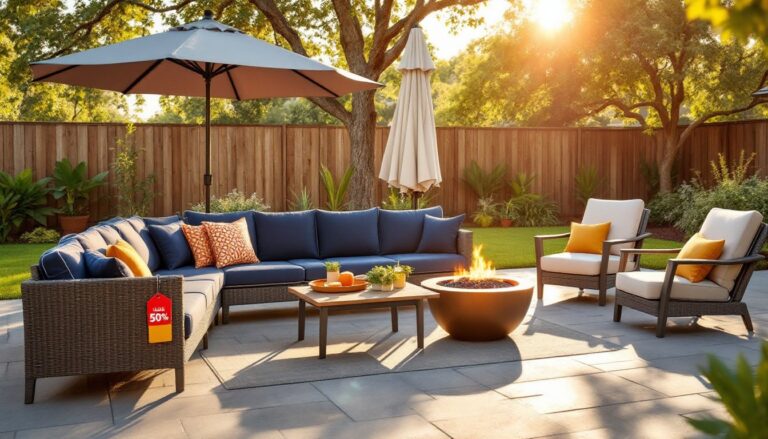
L-shaped sectionals maximize seating without claiming the center of your patio. Traditional furniture arrangements, loveseat plus two chairs, for instance, create scattered footprints and leave gaps that can’t be used. An L-shaped set consolidates seating along two walls or into a corner, opening up the middle for traffic flow, a coffee table, or even a small fire pit.
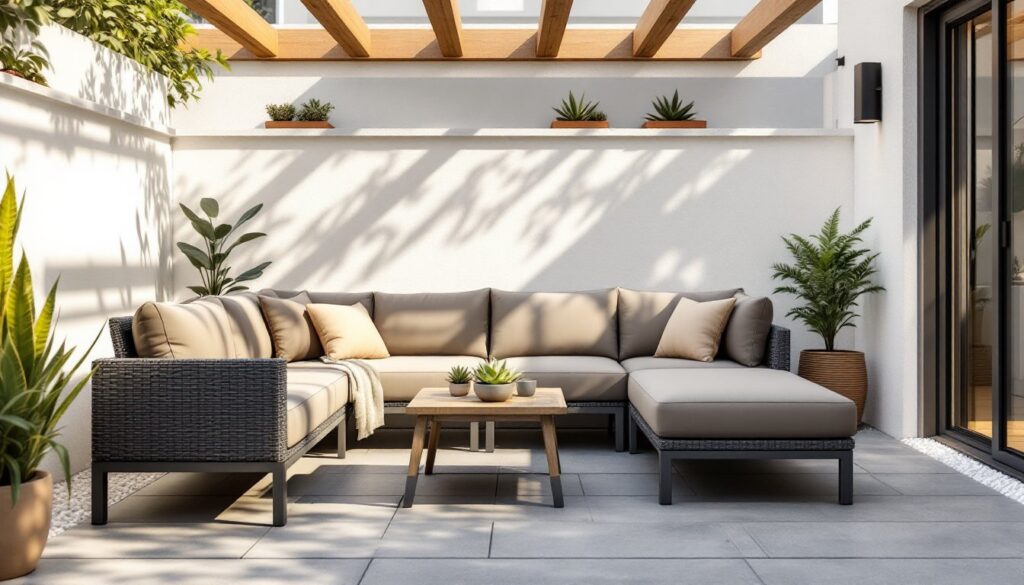
Corner modules anchor the configuration, eliminating dead space where walls meet. Most L-shaped sets include a corner seat (typically 30–36 inches on each side) plus armless middle sections and end pieces with arms. This modular approach lets owners configure the layout to fit odd angles or narrow dimensions that standard sofas can’t accommodate.
Another advantage: social geometry. L-shaped seating encourages face-to-face conversation better than a single straight sofa. Guests naturally angle toward one another, creating a more intimate vibe even in tight quarters. For patios used primarily for entertaining, this layout punches above its square footage.
Choosing the Right Size and Configuration
L-shaped sets come in wildly varying footprints. A compact three-piece (two armless seats plus corner) might span 60 × 60 inches total. A five-piece set can stretch 80 × 100 inches or more. Measure carefully, and remember that published dimensions rarely account for cushion overhang or armrest projection, add 2–4 inches per side to the frame measurements for real-world clearance.
Consider scale proportions. On a 10 × 12-foot patio, a set that eats up more than half the floor space will feel oppressive. Aim to leave at least 24–30 inches of walking clearance on the open sides and 12–18 inches between the sectional and any walls or railings behind it. Tight fits look intentional: jammed fits look like a mistake.
Modular sets offer the most flexibility. Homeowners can start with a two-piece corner-and-seat combo and add sections as space allows, or remove a module when moving to a smaller location. Avoid one-piece welded L-shapes unless the patio dimensions are perfectly matched, they’re nearly impossible to repurpose.
Measuring Your Space Before You Buy
Start with a scaled sketch of the patio. Use graph paper (¼-inch squares work well at ¼-inch = 1-foot scale) or a free online room planner. Mark all fixed features: door swings, grill locations, planters, HVAC units, and any overhead obstructions like pergola beams or ceiling fans. Furniture fits on paper don’t always account for three-dimensional clearances.
Measure diagonally across corners if placing the L-shape there. Many patios have roof posts or support columns right where a corner module would sit. Check for floor-level obstacles too, drains, uneven pavers, or sloped drainage angles can make modular furniture wobble.
Use painter’s tape on the patio surface to outline the furniture footprint at full scale. Live with the taped layout for a few days. Walk through your normal traffic patterns, practice opening the door with the layout in place, and test whether a coffee table or side table still fits where you want it. This step catches sizing mistakes before the delivery truck arrives.
Best Materials for Small Patio L-Shaped Sets
Material choice directly affects durability, maintenance, and visual weight, important when every inch counts. Aluminum frames dominate the small-patio market because they’re lightweight, rust-proof, and easy to reposition for seasonal cleaning or layout tweaks. Powder-coated finishes hold up well in sun and rain. Look for welded joints rather than bolted, they’re stronger and don’t loosen over time.
Wicker and resin rattan provide a softer look and often come in modular configurations ideal for tight spaces. PE (polyethylene) resin wicker resists UV fade and moisture better than natural rattan, which cracks and mildews outdoors. Inspect the weave density, tighter weaves (⅛-inch spacing or less) last longer than loose, chunky patterns. Frames underneath should still be aluminum or powder-coated steel, not bare metal.
Wood sets (teak, eucalyptus, acacia) bring warmth but require more upkeep. Teak weathers to a silver-gray patina unless treated with teak oil annually: eucalyptus and acacia need sealing every 1–2 years to prevent splitting. Wood is heavier, which can be a plus for wind-prone balconies but a drawback if you need to move pieces often. For very small patios, skip wood unless aesthetics outweigh practicality.
Cushion fabric matters as much as the frame. Solution-dyed acrylic (Sunbrella is the best-known brand, but others exist) resists fading and mildew and can be cleaned with soap and water. Cheaper polyester blends fade within a season and hold moisture, leading to mold. Quick-dry foam cores beat standard polyurethane, water drains through rather than pooling inside. Budget an extra $200–$400 for quality replacement cushions if the included set is low-grade: it’s cheaper than replacing the whole sectional in two years.
Smart Layout Ideas to Optimize Your Space
The long leg of the L can define a zone boundary. Position it perpendicular to the house to create a separate “room” feel, with the sectional acting as a visual divider between lounging and dining areas (if space allows for both). This works especially well on deeper, narrower patios where side-to-side width is limited but length is generous.
On square or nearly square patios, center the L-shape’s corner module in one corner of the space, angling the legs toward the middle. This creates a cozy conversation nook while leaving the opposite corner open for a compact bistro set, a vertical garden wall, or even a small storage bench. Studies on outdoor space design show that layered zones, even in small footprints, increase perceived area.
For apartment balconies or very narrow patios (under 6 feet wide), consider a floating layout: place the L-shape away from all walls, using the sectional back as a railing buffer or planter shelf. This unconventional approach works when the sectional is the only furniture piece and creates surprising visual breathing room. Pair with a nesting coffee table or foldable side table that tucks away when not needed.
Corner Placement vs. Wall Placement Strategies
Corner placement is the default for L-shaped sets, and for good reason: it maximizes usable floor area and keeps traffic lanes open. The sectional becomes a built-in feature, almost like a banquette. This layout works best when the patio corner is 90 degrees (or close) and free of obstructions like downspouts or light fixtures.
But wall placement, running the L-shape along a single wall with the short leg extending into the space, can be smarter for patios with off-center doors or narrow side access. This setup maintains a clear path from the door to the yard or pool and visually elongates the patio. It’s also easier to add or remove a module later without disrupting the entire layout.
Test both orientations with your taped floor plan. Walk from the door to the most-used destination (grill, stairs, garden gate) and see which layout feels less obstructed. If corner placement forces a zigzag path, wall placement might win. Conversely, if wall placement blocks a window or creates an awkward dead-end, stick the sectional in the corner.
Storage and Multi-Functional Features to Consider
Small patios can’t afford single-purpose furniture. Look for L-shaped sets with under-seat storage compartments, lift-top seats or slide-out drawers built into the base. These are perfect for stashing cushions overnight, storing outdoor toys, or holding grill tools and charcoal. Storage capacity varies: some sectionals offer 3–5 cubic feet per seat, others barely fit a few throw pillows. Check the load rating on lift-tops to ensure the hinge hardware can handle repeated use.
Convertible ottomans or modular corner tables add flexibility. A corner wedge that doubles as a drink table or footrest eliminates the need for a separate side table. Some high-end sets include a corner module with a removable tray top that reveals storage underneath, ideal for small spaces where every piece must multitask.
Integrated planters and side shelves are gaining traction in 2026 designs. A few manufacturers now offer end modules with built-in planter boxes (typically 8–10 inches deep) or slatted shelves for lanterns and speakers. These features reduce clutter and keep accessories within arm’s reach without occupying extra floor space. Modern furniture design trends emphasize modularity and hidden function, especially in urban outdoor living.
Finally, consider stackability. If winter storage is tight or the patio doubles as a walkway during snowy months, modular pieces that stack or nest make seasonal transitions easier. Armless middle sections often stack three or four high: corner modules are trickier but some nest if flipped. Check product specs, stackable sets aren’t common, but they’re worth the search for space-constrained owners looking at patio furniture options.
Safety note: Any furniture with lift-top storage should include soft-close hinges or safety stays to prevent lids from slamming on fingers, especially in homes with kids. If the set you’re eyeing lacks them, aftermarket lid supports are available at most hardware stores for under $15 per seat.